Research Report: Linear Guides: The Cornerstone Of Precision Motion
Jul 28, 2025
This research report focuses on linear guides, a key mechanical component, and discusses in depth its definition, working principle, characteristics, classification, application areas, market status and future development trends. Through the analysis of relevant data and research on industry dynamics, it aims to provide readers with a comprehensive and in-depth understanding, help practitioners seize market opportunities, and promote technological innovation and development.
1. Introduction
In the field of modern industrial automation and precision manufacturing, linear guides play a vital role. Like the "skeleton" of the equipment, it supports and guides the moving parts to achieve high-precision, low-friction linear motion, and is widely used in various high-end equipment such as CNC machine tools, semiconductor manufacturing equipment, and packaging machinery. As the manufacturing industry moves towards intelligence and high speed, the performance requirements for linear guides are also increasing, prompting continuous technological innovation and product upgrades in this field.
2. Overview of linear guides
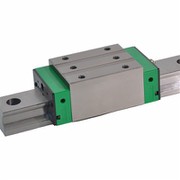
Definition and composition: Linear guides are a type of precision mechanical element used to guide and support moving parts to move along a linear path, mainly consisting of guide rails and sliders. The guide rails are usually made of high-precision steel, and the surface is precisely processed to provide a stable motion trajectory for the slider; the slider contacts the guide rails through balls or rollers to achieve low-friction linear motion.
Working principle: Taking the ball linear guide as an example, it uses the rolling of the ball between the guide rail and the slider to replace the traditional sliding friction, thereby greatly reducing the friction coefficient, so that the load platform can easily move linearly along the guide rail with high precision. This rolling guide method not only improves the smoothness and accuracy of movement, but also reduces energy loss and extends service life.
3. Characteristics of linear guides
High-precision positioning: The point-to-surface contact design significantly reduces friction resistance, allowing the moving parts to achieve subtle and precise movement, and can achieve micron-level positioning accuracy to meet the needs of precision processing and measuring equipment. For example, after being applied in the microscope stage of medical equipment, the movement accuracy can reach 0.1 microns, which is equivalent to 1/800 of a hair, greatly improving the accuracy of the operation.
High load capacity: Since the ball has its own rolling groove, the force is evenly dispersed, and the linear guide can withstand a large load, which is suitable for heavy-duty handling and other application scenarios. Whether it is a tool for a large machine tool or a working platform for heavy machinery and equipment, it can rely on linear guides for stable support and precise displacement.
Efficient heat dissipation: Less friction heat is generated during operation, and it is not easy to deform due to heat, so it is suitable for high-speed movement occasions. This feature ensures that the equipment can still maintain good performance and stability under long-term high-speed operation, and will not affect the accuracy or damage the parts due to overheating.
Balanced load distribution: The design ensures that the slider has the same rated load in multiple directions, making the load distribution more uniform and stable, and further improving the reliability and safety of the movement.
Convenient installation and debugging: Compared with other complex transmission devices, the installation and debugging process of linear guides is relatively simple, which reduces installation time, improves work efficiency, and facilitates rapid assembly and maintenance of equipment.
4. Classification of linear guides
Classification by rolling element type
Ball linear guide: Using balls as rolling elements, it has the characteristics of high precision, low noise, and simple maintenance. It is suitable for precision equipment such as CNC machine tools, coordinate measuring machines, etc.
Roller linear guide: Using rollers instead of balls, it has stronger load-bearing capacity, lower wear rate, longer service life, and better impact resistance. It is often used in heavy-load conditions, such as large stamping machines, injection molding machines, etc.
Classification by structural form
Square ball linear guide: It has high rigidity and stability and is widely used in various general mechanical equipment.
Double-axis core roller linear guide: It has two axis cores and can bear radial and axial loads at the same time. It is suitable for motion guidance under complex force conditions.
Single-axis core linear guide: It has a simple structure and low cost. It is suitable for some occasions with low precision requirements but limited space.
5. Application fields
CNC machine tools: In CNC machine tools, linear guides are used to guide the linear motion of the tool to achieve high-precision cutting processing. Its high-precision positioning and low friction characteristics effectively improve the processing efficiency and quality, and are one of the key components to ensure the performance of machine tools.
Semiconductor manufacturing: Semiconductor manufacturing equipment has extremely high precision requirements. Linear guides are used here for precision transmission and positioning to ensure accurate processing of wafers. The extremely high positioning accuracy and stability ensure the product yield and meet the strict standards of the semiconductor industry.
Packaging machinery: In packaging machinery, linear guides are responsible for guiding the transportation and positioning of packaging materials to achieve an efficient packaging process. The characteristics of high load capacity and long life enable it to adapt to the needs of long-term continuous operation and improve production efficiency.
Other fields: In addition to the above typical applications, linear guides are also widely used in 3D printers, VR equipment, automated production lines and other fields. For example, the nozzle of a 3D printer relies on the guide rail to move, and the printing error is less than 0.02mm; in VR equipment, the guide rail increases the sensor response speed by 3 times, bringing users a smoother experience.
6. Market status and competition pattern
Global market: In recent years, the market size of the global linear guide industry has shown a turbulent upward trend. According to data, the global linear guide industry market size in 2023 is about US$2.42 billion, and it is expected to reach US$2.86 billion in 2027, with an annual compound growth rate of 4.65%. This shows that with the development of manufacturing and technological progress, the demand for linear guides continues to grow.
Chinese market: Starting from 2021, the market size of China's linear guide industry has shown an upward trend year by year, and it will be about 660 million yuan in 2023. As a major manufacturing country, China has a wide range of downstream applications and huge market growth space. However, the domestic high-end market is still occupied by internationally renowned brands such as Schneeberg of Switzerland, INA of Germany, Rexroth, NSK of Japan, and THK; the mid-end market is mainly dominated by the competition of Hiwin and Intime of Taiwan, China; although there are many companies in mainland China, their overall strength is far behind that of overseas companies, and the industry CR5 exceeds 78%.
Competition trend: In order to enhance competitiveness, domestic companies have increased their investment in research and development, committed to improving product quality and technical level, and gradually penetrated into the mid-to-high-end market. At the same time, companies in the industry are also actively exploring the development direction of intelligence and integration to meet the diverse needs of the market.
7. Future development trends
Technological innovation direction
Miniaturization and nanometer-level precision: With the development of the trend of miniaturization of electronic equipment, the demand for miniature linear guides has increased, while pursuing higher precision to the nanometer level. This will prompt companies to develop new manufacturing processes and materials to meet this market demand.
Self-lubrication and long-life design: Develop linear guides with self-lubricating functions to reduce maintenance costs and extend service life. For example, special coatings or material processing technologies are used to give the guide surface good lubrication properties.
Integrated sensors for intelligent monitoring: Integrate sensors into linear guide systems to monitor operating status, temperature, load and other parameters in real time, realize fault warning and predictive maintenance, and improve the reliability and intelligence level of equipment.
Application of green materials: Increased environmental awareness has prompted companies to look for renewable and degradable materials to manufacture linear guides and reduce environmental pollution.
Integrated and modular design: In order to meet the diverse application needs, linear guides will develop in the direction of integration and modularization, making it convenient for users to combine and install according to different needs.
Application scenario expansion: The popularity of multi-axis and multi-degree-of-freedom systems will promote the widespread application of linear guides in the field of robotics and automation, and help upgrade the industry to intelligent and efficient. For example, in the fields of collaborative robots, logistics sorting systems, etc., linear guides will play an important role.
Conclusion
As an indispensable key component in modern industrial production, the performance of linear guides directly affects the accuracy, speed and reliability of equipment. With the continuous development of the manufacturing industry and the continuous innovation of technology, the linear guide industry will usher in a broader development space. Domestic companies should seize the opportunity, increase R&D investment, improve product quality and technical level, actively expand market share, and occupy a place in global competition. At the same time, paying attention to industry development trends and strengthening integration and innovation with other fields will bring more possibilities for the application of linear guides and promote the sustainable development of the entire industry.